
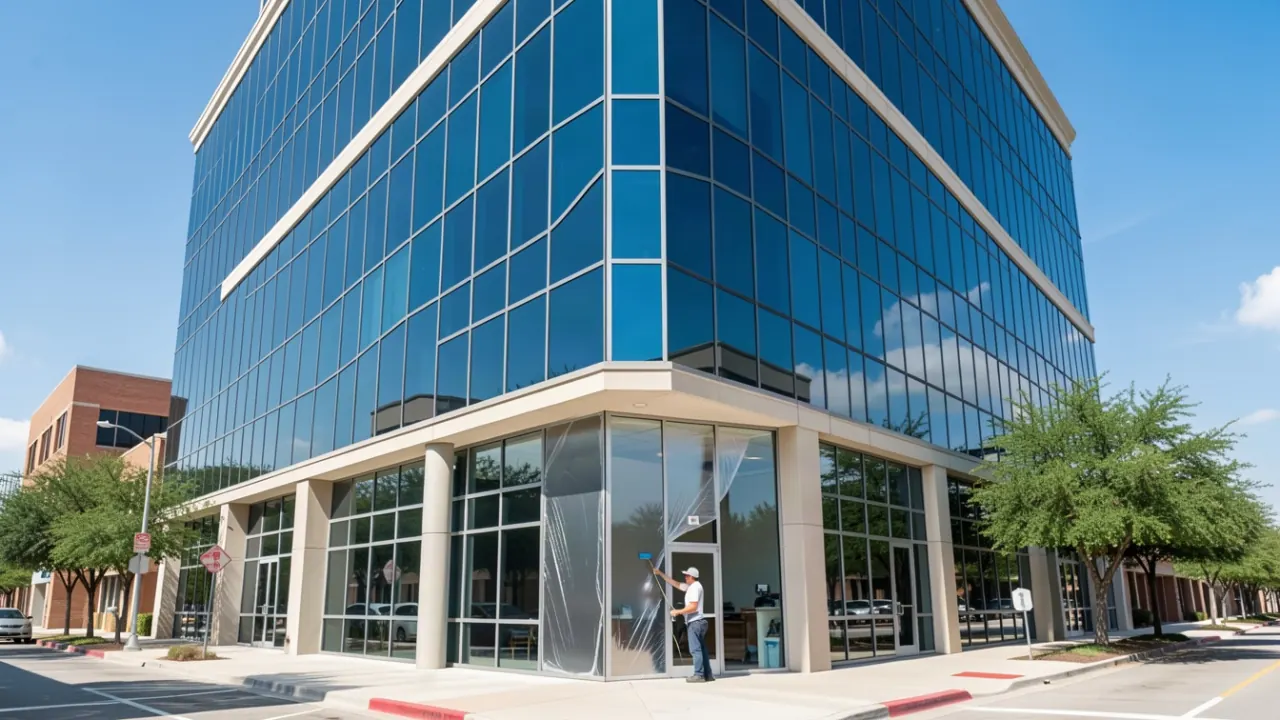
What decorative film gets used for
- Branded entries. A logo cut from frosted film on the suite door or sidelight.
- Partition patterns. Lines, dots, grids or gradients across glass office walls.
- Etched and sandblasted looks. The texture of treated glass, applied as film.
- Color. Tinted or translucent colored film on accent glass.
- Glass you can see. Bands or dots on large clear panes so people notice the glass before they walk into it.
- Bird-safe patterns. Markers on exterior glass near trees or water.
Most jobs mix two or three of these. A suite might get a logo on the entry glass, a frosted band across the conference room and a thin line pattern along a long glass wall, all done in the same visit.
Patterned film and bird strikes
This is the part of decorative film most owners have never heard about. The US Fish and Wildlife Service guide on low-cost ways to reduce bird collisions with glass says birds do not see clear or reflective glass, so they fly toward reflected sky and plants. It reports that vertical stripes at least a quarter inch wide spaced no more than 4 inches apart have worked for most birds, as have horizontal stripes of the same width spaced no more than 2 inches apart. Dots need tighter spacing than stripes. Film on the outer surface works best; inside film is the fallback when the outside can't be treated.
If your building has a problem pane, ask the installer for an exterior-rated pattern that meets that spacing.
Signs it's time
- A new tenant inherited the last tenant's logo, or none at all
- People keep bumping into a clear glass wall
- The lobby glass looks dated next to a fresh renovation
- A room needs some privacy, but plain frost feels too clinical
What is involved, in five steps
- Brief. Say where the film goes, what it should show and any brand colors. Have your logo as a vector file if you have one.
- Design proof. You get a drawing with sizes and placement on each pane. Approve it before anything gets cut.
- Measure and produce. The installer measures every pane, then plotter-cuts or prints the film.
- Install. Lines get leveled across panes so patterns match from one piece of glass to the next.
- Review. Walk the space, check alignment and edges, and get care instructions for the cleaning crew.
What decorative film costs
| Decorative film type | Installed price reported | Source |
|---|---|---|
| Decorative film | $6 to $15 per sq ft | Angi cost guide |
| Decorative and frosted, commercial | $9 to $16 per sq ft | Commercial installer price guide (2026) |
| Smart or switchable film | $30 to $100 per sq ft | HomeAdvisor cost guide |
| Removing old film | adds $2 to $5 per sq ft | Commercial installer price guide (2026) |
Custom printing and design time may be priced on top of the film, so ask whether the quote includes the proof. These numbers are guides; a measured quote replaces them. See the cost page for more on pricing.
What to ask the installer
- Can you produce this from our logo file, and who keeps the artwork?
- Is this film rated for exterior use, if it goes outside?
- How long before the color or print is likely to fade in direct sun?
- How do we clean it without lifting edges?
- Can it be removed cleanly when the design changes?
Decorative film pairs well with privacy window film on the same partitions. For a full suite fit-out, see office and storefront tinting.
Areas we cover for decorative window film
Window film FAQ
Can decorative film show our logo in color?
Yes. Logos can be cut from frosted film for an etched look or printed in color on clear or white film. Send the installer a vector file of the logo and ask for a proof showing exact size and placement before production.
Will decorative film hold up on a busy entry door?
It goes on the glass, not the handle, so normal traffic is fine. Edges are the weak point, so ask how the installer finishes them near push plates. Use a soft cloth and a mild cleaner rather than a scraper.
Does decorative film on the inside of the glass stop bird strikes?
It can help, but less than outside film. Fish and Wildlife Service guidance says treating the outer surface is most effective, and inside treatment only works when the glass isn't so reflective that birds miss the pattern.
Can we change the design later?
That is one of the main reasons to use film over etched glass. The old film comes off, the glass gets cleaned and new film goes on. Removal adds cost, so budget for it when you plan a rebrand.